Recommendations aren’t fixed—they follow your signals
You open an app expecting the same kind of posts you liked last month, but the feed has shifted—more of one topic, fewer familiar voices, and a strange obsession with the one thing you clicked in a hurry. That change usually isn’t random. Most recommendation systems treat what you do as a steady stream of hints: what you watch to the end, what you skip fast, what you search, who you follow, what you linger on, and what you hide.
Your “signals” aren’t always intentional. A curiosity click, a doomscroll session, or letting a video autoplay while you cook can look like a preference. Systems also have limited room to test new ideas, so they may temporarily lean into a theme to see if you engage, even if it makes the feed feel narrower.
How systems translate behavior into “interest”
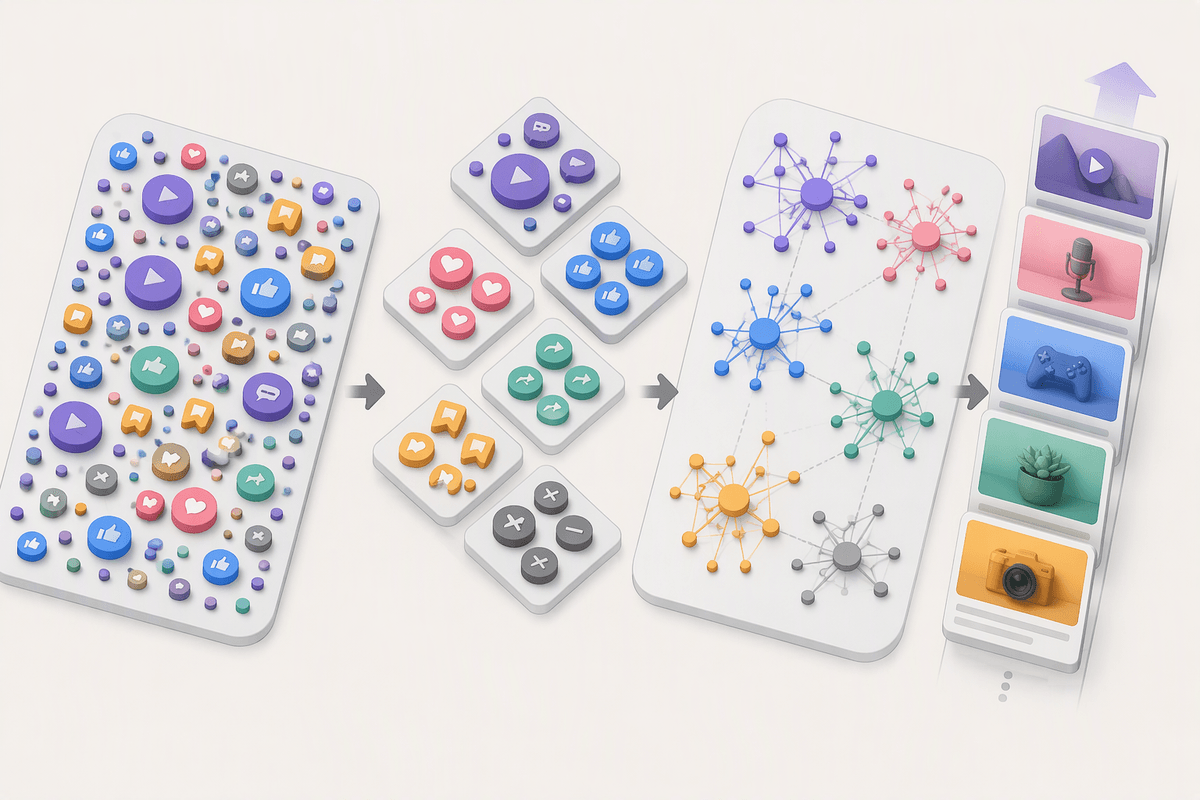
Most systems don’t store a single label like “you love cooking.” They build a working guess from many tiny events, each with a weight. A long watch, a rewatch, a save, a share, or clicking through to comments usually counts as a stronger vote than a quick like. Skips, fast scrolls, mutes, and “not interested” actions count too, but they can be noisier because people skip for lots of reasons (time, mood, or the first two seconds were slow).
Those events get grouped into topics and patterns: the creator, the format (short clips versus long explainers), the time of day you engage, and what you tend to do after. That’s why one late-night rabbit hole can produce a week of similar suggestions. It’s efficient for the system, but it’s also a practical constraint: it can’t ask what you meant, so it treats behavior as meaning.
Why recent actions can outweigh long-term taste
You can watch a certain kind of content for years, then have your feed swing after a single weekend. That’s because many systems treat recent actions as the clearest clue about what you want right now. If you suddenly start searching for “running shoes,” the system has a practical reason to react quickly: you might be shopping, training, or dealing with an injury, and stale suggestions would miss the moment.
Recency also helps systems handle changing contexts they can’t directly see. A few watches during a commute, a burst of stress-scrolling, or a new project at work can shift what you click, even if your core taste hasn’t changed. The short-term behavior can be over-read. A few strong signals—long watches, repeated searches, commenting—can outweigh a longer history, especially when the system has limited space to show variety and is trying to reduce the risk of showing something you’ll ignore.
The stability vs freshness trade-off in rankings

You can usually feel when a ranking is tuned for stability versus freshness. A stable feed keeps returning to the same creators and themes, even if you only half-watch, because the system is leaning on what it’s confident about. It’s safer: fewer surprises, fewer obvious misses, and more predictable performance for the platform. The cost is boredom and repetition, especially when your interests are changing faster than your history can reflect.
A fresh feed takes more chances. It pulls in newer topics, adjacent categories, and recently popular posts to see what sticks, which can make it feel “alive” one day and confusing the next. This isn’t just a taste choice; it’s a practical balancing act. Every slot taken by something new is a slot not used for a proven favorite, and new items have less data, so the system is guessing more. If your recent signals are noisy—autoplay, background listening, quick curiosity clicks—freshness can amplify that noise into a temporary identity.
Feedback loops that amplify what you engage with
Watching one clip all the way through may be enough for a feed to treat that topic as a lasting preference. This is how the feedback loop develops. The system recommends content based on what it predicts you will enjoy, then uses your clicks, watch time, and other interactions to guide the next round of recommendations. Similar posts are relatively easy to rank and tend to generate predictable responses, so repeating familiar formats becomes an efficient way to keep engagement steady.
Over time, this cycle does more than reflect existing interests. Repeated exposure influences what appears on the screen and, in turn, what gets clicked next. When people are tired, busy, or simply curious, they may watch whatever appears first. The system interprets that interaction as further evidence of interest, even when it says little about their actual preferences. Eventually, narrow content clusters may push out more varied material, while creators increasingly imitate formats that have already performed well.
For platforms, introducing unfamiliar content carries a risk: users may skip it, leave sooner, or spend less time scrolling. Familiar recommendations are more predictable, which helps explain why feeds may continue repeating similar posts even after interests begin to change. Strong signals, such as repeatedly skipping a topic or actively choosing different content, may be needed before the system starts adjusting its recommendations.
When changing recommendations signals drift or bad data
You also get shifts that aren’t really “you” at all. Signals drift when the system’s idea of what a click means changes: maybe a longer watch used to imply interest, but now it’s common to let videos run in the background, or a new format encourages more tapping without deeper intent. If the platform tweaks how it measures satisfaction—less weight on likes, more on rewatches, more on time spent—your past behavior gets reinterpreted under a new scoring rule, and familiar patterns can stop winning.
Bad data can creep in through normal life: a partner borrowing your phone, kids watching cartoons, research for work, a one-time health scare, or even a pocket tap. Shared devices and shared accounts are obvious culprits, but “soft sharing” matters too, like casting to a TV at a friend’s place. The system can’t reliably label intent, so it tries to explain the new behavior as a new you. Without strong corrective actions, a small contamination can become a durable theme.
Using this understanding to regain control and trust
Think of your feed as steerable, not fate. If it’s gone narrow, start by changing what you reward: finish fewer borderline videos, avoid “hate-watching,” and use explicit controls like “not interested,” mute, unfollow, and clear recent searches where available. Add counter-signals on purpose—seek out a few creators or topics you actually want back, then watch them deeply, save, or share so the system gets a clean read.
Resetting can take days, and some platforms optimize for short sessions or trends, so variety may cost you a few “misses.” Separate contexts when you can: different profiles, private browsing for research, and tighter control of shared devices.