When “high accuracy” fails outside the lab
A model can look excellent in a demo: 98% accuracy on training data, confident predictions, clean charts. Then it hits real usage—different customer behavior, messier inputs, slightly changed wording, new edge cases—and performance drops. The surprise usually comes from treating “accuracy” as a single score rather than asking where that score was earned and whether the same conditions exist in production.
In the lab, you control the data and the questions. In the wild, you inherit missing fields, shifting trends, and people who don’t behave like your sample. Closing that gap takes time and budget for better evaluation, ongoing monitoring, and sometimes accepting a simpler model that tests lower but holds up better.
Overfitting explained in plain, practical terms
Overfitting is what happens when a model learns the training data too specifically. It doesn’t just learn the underlying pattern you care about; it also learns quirks that won’t repeat, like odd phrasing, one-off customer behavior, or random noise. A useful analogy is studying for a test by memorizing last year’s answer key. Your score looks great on that exact sheet, but it doesn’t prove you understand the subject well enough for new questions.
In practical terms, an overfit model is “right for the wrong reasons.” It can be extremely confident because it has found a complicated set of rules that match the training examples, even if those rules don’t generalize. This is more likely when the dataset is small, the labels are noisy, the features leak information from the future, or the model is flexible enough to fit almost anything. The cost is predictable: you trade reliable performance in production for impressive numbers in a controlled evaluation.
How models accidentally “memorize” your data

A common way memorization sneaks in is through “easy shortcuts” hidden in the inputs. If your dataset includes user IDs, ticket numbers, device fingerprints, store locations, or other high-cardinality fields, a flexible model can learn that “customer 18492 usually churns” instead of learning why customers churn. Even without explicit IDs, the same effect happens when rare phrases, templates, or formatting cues line up with the label. The model isn’t cheating on purpose; it’s simply optimizing for the fastest path to lower error.
Memorization also comes from accidental train–test contamination. Duplicate or near-duplicate records, repeated sessions from the same account, and time-based leakage (using features computed after the outcome) can make evaluation look much better than reality. This is why small details in data splitting matter, and why cleaning and de-duplication cost real time. The payoff is that you stop rewarding the model for remembering yesterday’s answers and start measuring whether it can handle tomorrow’s.
Early warning signs before you ship
You can often spot overfitting before deployment by looking for “too good to be true” behavior in evaluation. The most obvious flag is a large gap between training performance and validation or test performance—especially if training keeps improving while validation stalls or gets worse. Another sign is extreme confidence on predictions that should be ambiguous, such as perfect certainty on messy text, low-quality images, or sparse customer profiles. If a small change in data splitting (by time, by user, by region) causes metrics to swing wildly, it suggests the model is relying on accidental overlap or narrow patterns.
Look for brittleness in simple stress tests. Shuffle or remove suspicious fields (IDs, timestamps, rare tokens) and see if accuracy collapses. Compare performance by cohort: new vs. returning users, new product lines, recent weeks vs. older weeks. A practical constraint is that these checks take extra data work and compute, and they can slow shipping. But they’re cheaper than learning after launch that your model only worked on the dataset you already had.
Why overfitting hurts real-world performance most
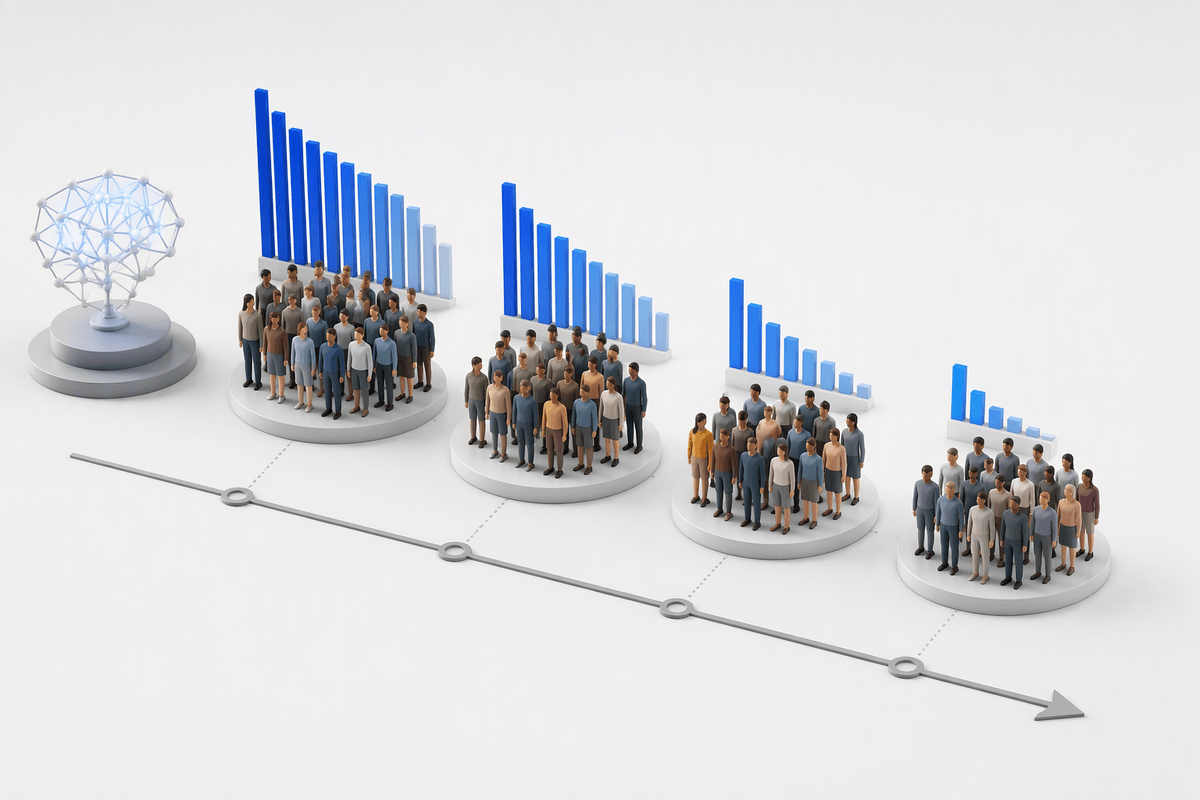
In production, the world keeps moving while your training set stays frozen. Customer mix changes, policies and UI flows get updated, marketing campaigns shift intent, and new edge cases appear the moment you launch. An overfit model is tuned to yesterday’s specifics, so these normal changes don’t just lower performance a little—they remove the fragile cues the model depended on. That’s why the drop often shows up first in the exact cohorts you care about: new users, new regions, newly launched products, or recent time periods.
Overfitting also makes operational risk harder to manage because it fails in “surprising” ways. You may see high confidence on wrong answers, unstable rankings, or sudden metric cliffs after a small upstream change (a new form field, a revised template, a vendor data update). The practical cost is that you end up compensating with manual reviews, higher support load, and emergency retraining cycles. Even if you can retrain quickly, data collection, labeling, and re-validation still take calendar time, and the business impact happens in the gap.
What actually reduces overfitting (and tradeoffs)
The most reliable fix is more representative data: more rows, broader coverage, and cleaner labels. That can mean collecting newer time windows, sampling the long tail of edge cases, and fixing systematic labeling errors. The tradeoff is straightforward: it costs time and money. You may need weeks to gather events, pay for annotation, or negotiate access to upstream data, and you still have to re-run evaluation with splits that reflect how the model will be used (by user, by time, by account).
When you can’t just “get more data,” you reduce how easily the model can fit noise. Regularization techniques (penalizing overly complex solutions, adding dropout, using early stopping) often lower training scores but improve test stability. Simplifying the model or pruning risky features (IDs, overly specific text tokens, leaky aggregates) can do the same, with the obvious downside that you might also remove real signal and hit a performance ceiling. Data augmentation and noise injection can help for images and text, but they take experimentation and can backfire if the augmented examples don’t match production inputs. Ensembling can reduce variance, but it increases compute cost, latency, and operational complexity.
A realistic way to balance fit and generalization
You usually don’t “solve” overfitting once; you manage it like any other reliability risk. Treat training metrics as a debugging tool, and make your go/no-go decision on a validation setup that matches deployment: split by time, user, or account, and keep a truly untouched test set for final checks. Pick the simplest model and feature set that meets the product goal, then add complexity only when it buys stable lift across cohorts, not just a headline score.
Operationally, assume drift and plan for it. Ship with monitoring, thresholds, and a rollback path, and budget for retraining cycles that include fresh data and re-validation. The practical constraint is calendar time: collecting new examples and labels is often the slowest step, so designing a repeatable evaluation pipeline matters as much as the model itself.